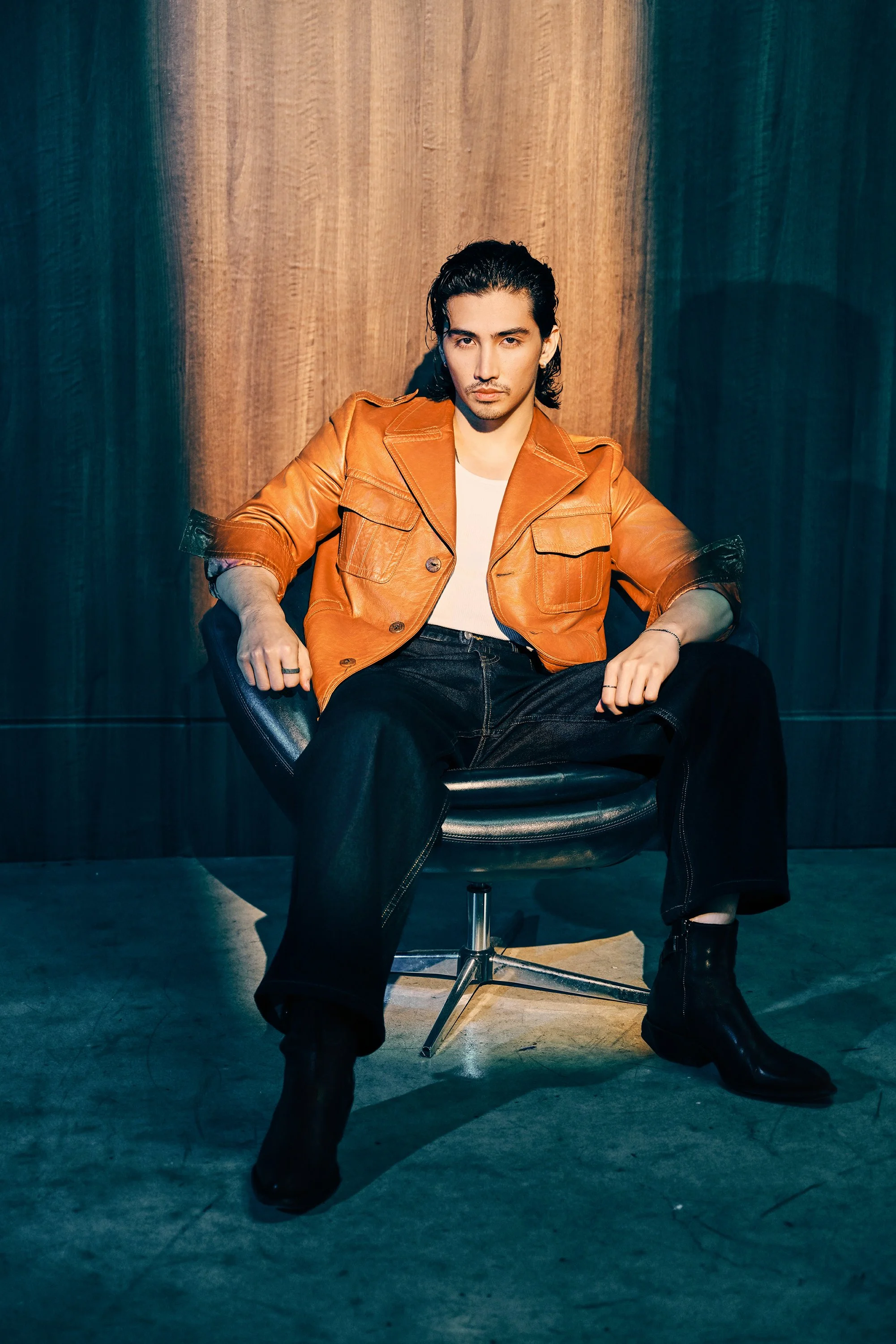
ETERNALLY YOURS’ PARKER YOUNG ON FINDING FOREVER IN A FLEETING WORLD
INTERVIEW BY IRVIN RIVERA
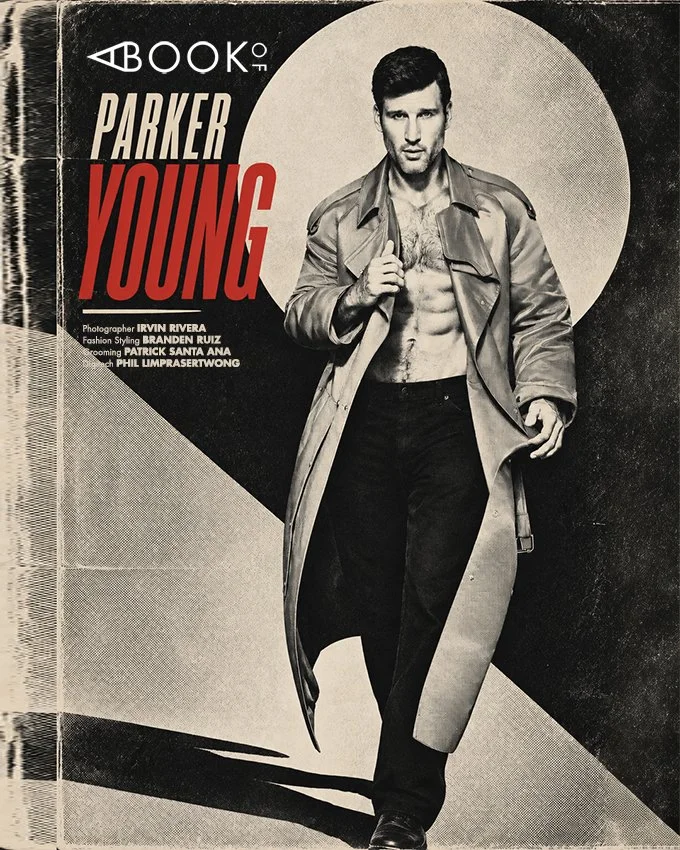
Photographer: IRVIN RIVERA, Styling: BRANDEN RUIZ, Grooming: PATRICK SANTA ANA, Digitech: PHIL LIMPRASERTWONG
PARKER YOUNG has spent much of his life learning that the roles we play are not always the people we are. Once a football player chasing victories beneath the Arizona sun, he traded the roar of the stadium for the unpredictable theater of Hollywood, where applause can be fleeting, rejection can linger, and first impressions have a habit of becoming permanent labels. The handsome jock, the charming heartthrob, the dutiful soldier. Young has worn them all, but beneath the familiar faces is a man more interested in what happens when the costumes come off. Nearly two decades into his career, the actor has discovered that life's most meaningful performances rarely happen in front of a camera. They happen in the quiet chaos of raising three daughters, in a marriage that has weathered more than twenty years, and in the courage to keep creating something beautiful without knowing whether anyone will applaud.
Perhaps fittingly, Young's latest role takes the idea of love enduring through time quite literally. In CBS's supernatural comedy Eternally Yours, created by Joe Port and Joe Wiseman, with a pilot directed by Trent O'Donnell, Young joins Ed Weeks, Allegra Edwards, Jaren Lewison, Helen J Shen, and Rose Abdoo as Jesse, a vampire whose devotion to his wife, Phyllis, is as complicated as his immortality. Behind the fangs and the laughter lies a familiar question: How do we continue choosing the people we love when time changes everything, including ourselves? For Young, who has spent much of his life growing alongside his high school sweetheart, the answer reaches far beyond fiction. In this conversation with A BOOK OF, he reflects on the bruises of rejection, the surprising lessons of fatherhood, the beauty of imperfection, and the freedom of finally trusting his own instincts. "I think when something truly feels like yours, you don't need outside validation to keep going," he shares. "You'd want to do it even if nobody ever applauded." For a man who has made a living playing other people, perhaps the greatest accomplishment is learning to be entirely himself.
You grew up in Tucson as a serious athlete and eventually became captain of your high school football team. Then concussions helped close that path just as acting was beginning to open another one. How did you learn the difference between something you're good at and something that actually feels like yours?
I loved being an athlete. I was good at it. I still love to compete. But ultimately, acting feeds my soul and challenges me to grow as a person in a way that sports never quite did.
I think when something truly feels like yours, you don't need outside validation to keep going. You'd want to do it even if nobody ever applauded. At least in theory. Actors can be funny creatures, and all too often we get trapped in an insatiable desire for approval. We crave that emotional response from an audience, whether it's laughter, tears, or applause. But I don't think that can be the driving force behind creating something.
I continue to learn this lesson from my kids every day. When they sit down to make artwork, it's not because they want to be good at it. It's because they want to create something beautiful and personal to give to me or their mom. It doesn't matter if it's perfect. In fact, the imperfections are often what make it beautiful.
And I think that's what I'm striving for in my own work. To create something not because I need approval, but because I have something I want to give.
I try to make my work an offering. To the world, to the universe, to God. A tribute to the people I love.
And when I do that, I know it's mine.
When you first came to Los Angeles, a lot of the opportunities available to you understandably responded to what people could see immediately: the athlete, the model, the handsome guy, eventually the lovable jock in Suburgatory. How did you keep other people’s first impression of you from becoming your own definition of yourself?
I've always loved that line from Tropic Thunder, where Robert Downey Jr.'s character says, "I'm a dude playing a dude disguised as another dude." Even though it's meant to be a joke, as a young actor, that line always resonated with me.
There I was, Parker Young the human being (a dude), putting on the mask of the actor I wanted the world to see (playing a dude), who was then portraying a character in a script (disguised as another dude). It's easy to get lost in all those layers, to mistake yourself for the disguise, when really you're just the "dude" underneath.
I never had much trouble separating other people's flattering impressions of me from how I saw myself. I remember when I was on Suburgatory, playing Ryan Shay, the "lovable jock," an interviewer asked me what it was like being the hot guy on the show. I told them, "I don't feel like I'm the hot guy. I'm just good at pretending to be the hot guy."
And I think there's some truth in that beyond the joke. While I never really let Hollywood's praise define me, I did let its rejection influence how I saw myself. After being told no enough times, I started to question whether I was good enough. So when opportunities finally came along, I sometimes felt like an imposter, like I'd somehow fooled everyone into believing I belonged there.
As I've gotten older, I've become more comfortable with who I am and what I bring to the table as an artist. But at the end of the day, I'm still just a dude playing a dude disguised as another dude.
You once said the defining moments of your career weren't the jobs people know you for. They were the hundreds or thousands of auditions you didn't book and the moments when you had to decide to continue anyway. After almost two decades of acting, how has your relationship with rejection changed? Does it still wound the same part of you, or have you finally stopped allowing a "no" to say something about your worth?
I mean, it still sucks. In fact, I'm not sure it sucks any less. It might even suck more.
Now, as a father, my time is so precious to me. I'm more aware than ever of how fleeting life is, and I have to be more intentional about how I spend my time. So when I put countless hours, sometimes even days, into preparing for an opportunity and it doesn't go my way, it's a tough pill to swallow. It's easy to wonder whether that time could have been better spent doing almost anything else.
But that's the game we play. And I think what's changed is that I've gotten better at not allowing rejection to define me as a person. Not getting the job doesn't mean I'm not good enough. It just means that particular opportunity wasn't meant for me. I try to trust that things are unfolding as they're supposed to, even when I can't see the bigger picture.
And thankfully, I now have things in my life that are far more important to me than any job. Rejection might still sting just as much, but it doesn't carry the same weight it once did.
You also said years ago that what you missed most about football was being part of a team working toward the same goal. Acting initially felt much more individual to you. Looking at Enlisted, Imposters, United States of Al, and now Eternally Yours, you've repeatedly ended up in very ensemble-driven work. Do you think you've spent part of your career rebuilding the sense of team you thought you lost when football ended?
Absolutely. One of the things I love most about being on set is watching so many talented people come together to create something. Just look at the credits after any movie. Making a film or television show requires so many people, each contributing something unique, all working toward a common goal. The fact that anything gets made at all is a miracle to me.
Which is why I find it a little disheartening how quickly people can jump on social media and tear apart a project. Knowing how much time, effort, and love goes into making something gives you a deeper appreciation for the work and the people behind it.
I'd love to put on a couple more hats someday, maybe write or direct. I'm still hoping to find the right team of collaborators to embark on that adventure with.
At the end of the day, no matter what I'm doing in life, I'd always rather be doing it alongside people I love. That's what makes the journey worthwhile.
You've returned several times to men connected to service and uniform, from Enlisted to Riley in United States of Al, Ranger Campbell in 9-1-1: Lone Star, and even more recently military-adjacent characters. After spending that much time around different versions of duty and masculinity, what have those roles made you unlearn about what strength is supposed to look like?
I've had the privilege of portraying a number of service members throughout my career, and I'm fortunate to have many men and women who have served in my personal life as well.
I think strength often looks like what we've traditionally been taught. Being physically fit, rising to the occasion, never backing down, accomplishing the mission. But strength can also look very different.
There's strength in vulnerability. In admitting when you're struggling, when you don't have all the answers, or when you need help. And sometimes, there's tremendous strength in surrendering. In letting go of the need to control everything and trusting that there's a greater plan unfolding, even when you can't see it.
Not every problem can be conquered through sheer force of will. Sometimes strength means putting down your weapon and leading with love.
You've been unusually candid about fatherhood, including admitting that when your daughter was born, you didn't immediately feel the overwhelming rush of emotion you thought you were supposed to feel. How did becoming a parent change your relationship to those emotional scripts we inherit about how a person is "supposed" to feel? Has that made you a more honest actor too?
Becoming a father was tough for me at first. I've been vocal about that because all I'd ever heard was that it was supposed to be the best thing in the world. And when that wasn't immediately my experience, I wondered if something was wrong with me.
But it did become the best thing in the world. It just didn't start that way. Now, as the father of three young daughters, I often find myself thinking, if there's a heaven, I hope it's something like this. I wouldn't trade these years for anything.
My girls have made me a better man in just about every way, and they continue to challenge me to grow every day. And yes, I'd like to believe they've made me a more honest actor as well.
You and Stephanie have been together since you were very young, and you've spoken before about the danger of becoming complacent in a long relationship and the need to keep choosing one another. Jesse and Phyllis take that idea somewhere surreal because he remains physically unchanged while she continues to age. How has your experience of long-term love shaped how you understand a marriage where each person experiences time differently?
I feel really lucky to have found my person at such a young age. It came with its own challenges, and I'm far from a perfect partner or husband, but it's a beautiful feeling to know that you have your ride or die in this life.
When I asked Stephanie to be my girlfriend in high school, I never thought of it as something temporary. She's an incredible woman and mother, and I'm grateful that she continues to love, support, and choose me every day.
We've been together for over 20 years now, which is something pretty unique for a man my age. We've grown up together, changed together, and experienced just about everything life has thrown at us side by side. And I think that's one of the beautiful things about long-term love. You're not necessarily the same people you were when you first fell in love, but you keep choosing each other through all those different versions of yourselves.
So while Jesse and Phyllis have a pretty unique set of circumstances, I certainly have a lot of personal experience to draw from when building my relationships on screen.
There's also something darker underneath Jesse's sweetness. His efforts to protect the life he's built with Phyllis include withholding enormous truths from the person he loves, and the show even plays with him altering what she remembers. How do you preserve the comedy and his genuine devotion while still understanding that love doesn't automatically make every choice loving? Was finding that tonal balance one of the harder parts of creating him?
It's one of the things I love about Jesse, his complexity. It's easy to think you've got this guy figured out, but there's a lot going on beneath the surface. He's lived through a great deal of tragedy, carries a tremendous amount of pain, and loves fiercely. He strives every day to be a better man despite his more sadistic vampiric instincts.
I love getting to lean into the big comedic swings while still maintaining a real, grounded person underneath it all. And I think that's where the comedy works best, when the stakes are real, even if the circumstances are absurd.
It's true that love doesn't automatically make every choice loving. Sometimes the things we do to protect the people we love can actually hurt them. And sometimes we have to confront the very things we've spent our lives avoiding. There's a certain freedom in that, and it's something Jesse begins to learn early on in the season.
There's an interesting irony to your career. You entered a business that could look at you and immediately know how it wanted to package you. Athlete. Model. Heartthrob. Jock. Soldier. But you've spent years putting more complicated people inside those silhouettes. At this point in your life, what part of Parker do you think has taken the longest for other people to see? And maybe for you to see too?
I think people sometimes mistake my playfulness for a lack of depth. I've always been a pretty goofy guy. I love to have fun, especially on set, and I think that can sometimes give people the impression that I'm not taking things seriously.
But the truth is, I take my work very seriously. I spend a tremendous amount of time thinking about my characters, studying the craft, and trying to become a better storyteller. I just happen to believe that some of my best work comes from a place of play.
As for what I've been slow to recognize in myself, I think it's that I'm capable of more than I've given myself credit for. I've wanted to direct for a long time, but I've spent years wondering whether I'm ready, whether I know enough, whether I've earned the opportunity.
I'm starting to realize that maybe I'll never feel completely ready. At some point, I just have to trust myself and take the leap.
If you were a book, what book would you be and why?
I'd be a book of Dad Jokes.