
BENJAMIN LEVY AGUILAR CARRIES THE FIRE BENEATH CHICAGO P.D.
BY IRVIN RIVERA

INTERVIEW: IRVIN RIVERA, ART & CREATIVE DIRECTOR/PRODUCER, PHOTOGRPAHER: PHIL LIMPRASERTWONG. FASHION STYLING: ELIZABETH KENNEDY, GROOMING & HAIR: BRENDA ARELLANO, CONTRIBUTING PRODUCER: AC DE QUINA, PHOTO ASST: DANE THOMAS, STYLING ASST: KATE ADLER, LOCATION: FAIRMONT CHICAGO, MILLENNIUM PARK
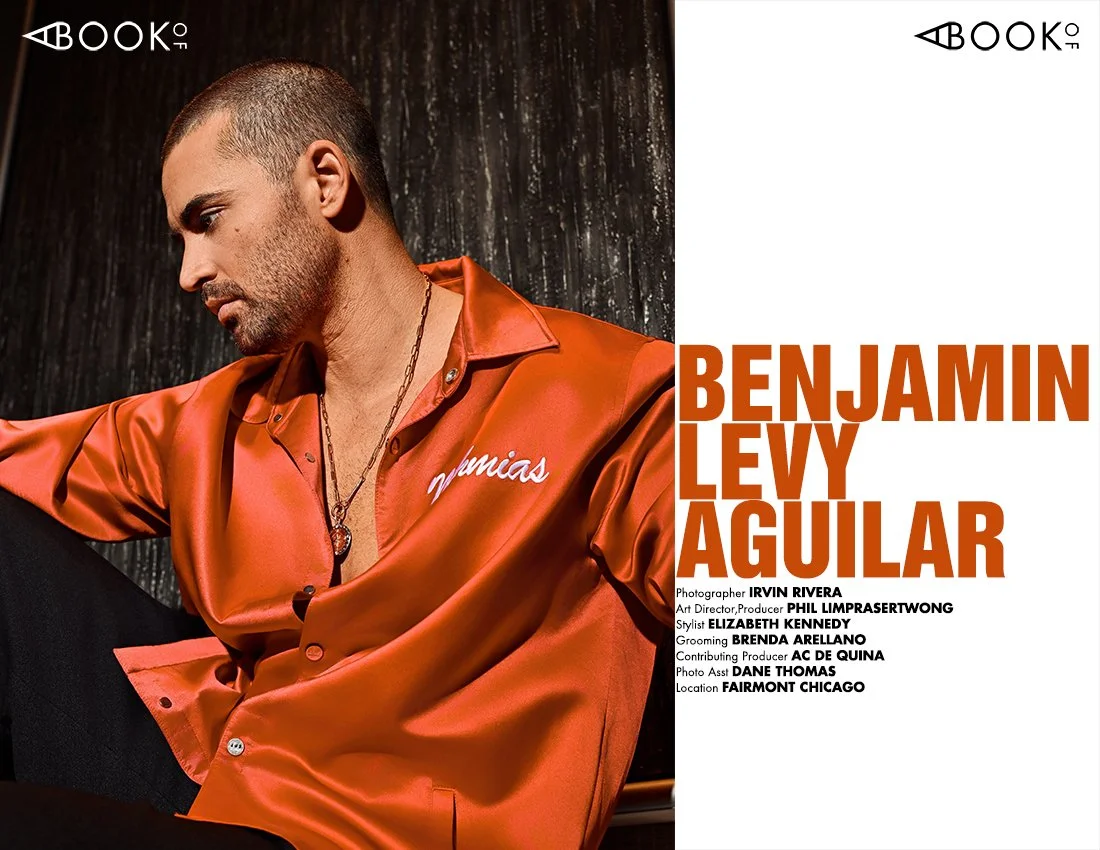
BENJAMIN LEVY AGUILAR does not enter a scene so much as he carries a whole weather system into it, quiet, watchful, and charged with something unsaid. On NBC’s Chicago P.D., the Dick Wolf and Matt Olmstead police procedural from the One Chicago universe, Aguilar joins Jason Beghe, Marina Squerciati, Patrick John Flueger, LaRoyce Hawkins, Amy Morton, and Arienne Mandi as Officer Dante Torres, a man shaped by faith, fear, loyalty, and the dangerous work of learning who he really is under showrunner Gwen Sigan.
In this interview (featured in our Collectors Print Issue), Aguilar speaks like someone who has survived enough to stop performing strength and start studying it. He traces Torres back to Guatemala, to the discipline learned through soccer, to the ache of reinvention, to the strange intimacy of speaking truth in Spanish, and to the inner compass that keeps pulling both the actor and the character toward something more honest. What emerges is not a simple portrait of toughness, but a man brave enough to admit that “the only way to be strong is to be vulnerable,” and that when the focus becomes absolute, “everything will yield to the power of your attention.”
When you think about your beginnings in Guatemala, what part of that life helped you understand Dante Torres most deeply?
I think, you know, I grew up in a very particular place, because Guatemala, when I grew up there, they had no middle class. It was just extremes- lower class and high class, very much like opposites, kind of, like I'd go to school with people that would, you know, hop out of helicopters to go to school, like a helicopter would land, and the kid would come out. But my car said ‘For Sale’ on the back, with soap. The difference in every sense was so big that I think I had to learn to navigate different worlds, you know. Being with extremely wealthy people, or training in places with former gang members, or you know, very tough people. So I think that Torres and I share that duality of life where I'm very comfortable navigating all aspects and hierarchies of worlds. Whether they get me or not. Some make me afraid, some intimidate me, but I'm able to flow through them both. I think that in a way, I've always called it a superpower of mine, and I think that Torres has that superpower,
And it shows on screen. It's like you said, it's very natural. It's almost like second nature.
Oh, cool. I'm glad that it shows.
And in relation to that, how did your hometown shape the way you think about strength, survival, and loyalty?
Oh, my God. I mean, survival is everywhere. I feel like I didn't grow up or like live there, I survived. I think that survival was a part of my growing up in every sense. Strength came with that. Strength came from survival and resilience. Loyalty is a very interesting word. I have friends who used to be in gangs, and I'd be talking about loyalty with them, and they'd show me their gang tattoo, and they’ll say, Hey, listen, if I were still loyal, I'd still be in this gang.
Loyalty is something we learn to belong in places, and it can be so detrimental if the loyalty is not towards yourself, right? And I think that Torres had to learn not to be loyal to what he learned to be loyal to, which was the gangs or the gang culture, or all the things that he was a part of. It comes to a point in person's life where you have to realize that, did I ever choose consciously to be loyal to this, or was this a product of my upbringing and what I want to be loyal to now, you know, so that's when I think he, he chose to do right and to protect people and become a police officer.
You mentioned loyalty to self at some point, right? So I think that's important too, not to have that blind sense of loyalty and to have that loyalty to self, which enables you to serve the people in the community around you, which is what Torees is doing.
Totally, because you're starting to realize your own integrity, right? Instead of being loyal to your family, who they told you you needed to be loyal to. What if your family is in the wrong? How do you react to that? You know what I mean? If you're already blindly loyal to your family, you'll defend them at all costs, even at the expense of someone else. But if you start realizing that you are your own inner compass, which is like my favorite thing, I have it here on my neck, you know, if you if you can guide yourself through your inner compass, your intuitions, then even morality and everything kind of takes it goes out the window, and you can start really going by your own antenna in this world. And I think that little by little, Torres is starting to realize that about himself
So personally. Now that you mentioned inner compass, how does one achieve that? How does one follow their inner compass?
I love these questions, man. I can talk about this all day. That's literally all I do all day. How does one do that? There is a way to do that, and the way to do that is to see your own mind, your own thoughts. If you start seeing your thoughts and you start realizing, Oh, wait, I'm not attached to my thought process, I can see behind my thought process and see how my thoughts operate, you realize that your thoughts are operating through a character that you've created for survival since you were little, right? So, once you see that, once you become aware of the thought, you can now see all the illusions that you've been living through. We, literally as human beings, meet someone and be like, Oh, nice to meet you… Blah, blah, and then in that moment, we are already seeing them through the perception of the character that we created when we were five years old. And we think it's true, and we completely like we put a nail on it, and that's it, and we define it, and we conclude it, and there's no more room for any exploration of anything. So the way to find your inner compass is to start doubting what you thought was the truth. You know what I mean? Have you read The Four Agreements? It's one of my favorite books, one of the first books ever read. And it says, like, agreements are based on 100% faith in the agreement itself. If you believe this, then there's absolute faith that that's what it is. So really, you have to start creating doubt in the agreement. And once doubt creeps in, now everything gets questioned in your mind, and you can start thinking, Oh, that's an interesting point of view that I'm having about that point of view. And now it shifts. And then the character and the thoughts are obliterated. And little by little, if you start creating doubt in all your agreements, eventually this becomes bright and shining.
Then it gives you discernment.
Yeah, exactly.
Man, that's great. And I think in line with that, when you get discernment, you are able to develop your own sense of discipline throughout your journey in life. Now, going back to you, soccer gave you discipline early on. How has that way of thinking stayed with you, both in life and in your work,
You know, it's so interesting. Soccer for me was a survival tactic, in a way, where it was an escape, but also an intuition. You're right, because I say escape because there was so much going on in my family, and it was so dysfunctional that I had to get away from the pain.
So I was like, you guys figure it out. Imma go play soccer. Then that turned into OCD, and I was like, if I don't do this or that, or if I don't become this soccer player, or if I don't hit the post 100 times in a row at the top, my mom is going to die. That's what my mind would say. So I would have to hit the post 100 times each night to save my mother. So that's incredible stress on a child, but it also made me a great soccer player. But then the third one was the intuition, I guess, of like, this is the way to survive. Don't go to drugs, don't go to jail, go play soccer and become this. And what that's created in me is one of the most important things I've learned in my life: if you put your focus 100% on something, it's going to happen. It's inevitable. So I applied the same thing in my acting career, and I applied the same thing when I became a black belt in Krav Maga, and I apply the same thing in anything- is if I really create my focus, not because I'm better than anyone, not because I'm anything, just because I'm absolutely focused, everything will yield to the power of your attention.
1,000% yes! Benjamin, many of the men you play feel tough on the outside but deeply human underneath. How do you find that balance in a way that feels very real?
I think that the greatest strength, honestly, not the greatest strength, but the only strength, comes from true vulnerability and humanity. So anything else beyond that would just be you putting on a facade and a character trying to be strong but truly very insecure underneath, which, unfortunately, is how many human beings live their lives. So I think that the only way to be strong is to be vulnerable. So I try, and I'm not an expert on it, but I definitely try to walk through life in touch with my humanity, not my facade. And I think that's the greatest strength, and that's immovable, you know,

Is this how you build that inner life for Torres as well, because the character feels very much layered and human?
Thank you. Definitely. My craft in acting has shifted so much since I started learning Stella Adler, Lee Strasberg, and Stanislavski, Meisner, and Chekov, and all these techniques, and I learned so many great things, but it did get into my head, and I thought that the more I learned these techniques, I would become a better actor. And I guess it's true in some way, but eventually, the more I grew in my life, the more I realized that my life growth was my acting process. The more I grew in my life, the deeper the characters I play would go. So I let everything go, and I just kept really diving into my own fears as a person, personally, and the more I was able to be comfortable with my fears, my embarrassments, my regrets, my anger, my hate, because we all have it- everything. We all have everything in there. The deeper my characters will go. So I think that Torres is just an extension of my own inner work, you know, and in different circumstances, I can understand now why someone would do that, even if it's something morally incorrect that maybe I wouldn't do. Now I don't judge it because I've done the work and realized I could do it in some circumstances. Everyone will be capable of doing anything in any circumstances, because we've all hit all the frequencies, man, we've all hit the frequency of hate. And the same frequency of hate is the same frequency that the most “terrible people” have hit. And you've hit it at some point in your life. And you've hit the frequencies of the Gandhis in the world and all these enlightened beings as well. You've hit all the frequencies. So once you're able to hit the frequencies, and you've consciously realized you've hit all the frequencies, what is there to judge anyway, you know? So now you can just jump into life, or into an art, or into a character, without any fear of getting hurt or of judging it, because now you are that.
You can tap into it.
You can tap into it because you're always there for your family in the game of life. You can tap into it anytime you want to. We just choose not to. Hopefully, knowing there are lower frequencies, hopefully we choose not to tap into it, but we can get there. We get there all the time unconsciously. So, right, the only goal is to just consciously get there. And then, it's game over. Then you can tap into anything.
It just and then it just flows everything, kind of flows naturally, exactly, Oh, I love this.
I can literally stay with you and talk about this all day.
No, for real, I feel like you have, like, this deep understanding of the shadow work and how your subconscious is, you know, manifesting to your conscious and to your art, which is really impressive, and that really makes whatever you do so genuine to your audience. You know, like, because, as you were saying earlier, the facade is just not there anymore.
It's not there. You know, you can see life directly. I was just talking to a friend, literally 30 minutes ago, and it's incredible we as artists or specifically actors, I guess, I don't know specifically, but I was thinking, as an actor, we are able to channel energy through a character, but not just that, but we are also the channel in which the audience perceives the the world we're living. We are not just channeling the character; we are the channel through which the audience sees something and is impacted. So the more you can be free from your own bullshit, the more you're just a vessel or a transparent, translucent, porous being that they can tap into their own perception. The audience can tap into their own perception. It's really fascinating, isn't it?

It is, it is 100%, and I really love that you're saying this because I've seen different performances. Experience it myself as an audience, and I can tell the difference between a genuine performance and a performative one, if that makes sense. Now speaking Spanish in Chicago. PD gave Torres another layer of truth. How did that shift your connection to the character? I mean, how does that shift your connection to the character and your connection to the audience?
Well, you know, what's interesting is that when I do therapy, I do therapy in Spanish, because it's my native language. So I've learned that in my subconscious, the deepest things that I can tap into. It's easier to tap into in your native language when you speak it in private, you know, with my eyes closed, especially if I'm doing some sort of trauma work. If I speak of my fears or whatever it is that's going on, or my truth in Spanish, it hits a different level of subconscious in me, and I kind of felt the same way when I was speaking Spanish in Chicago, PD scenes, it was so much easier to connect to emotion. It was so much easier to connect to the truth. It was so much easier to be truthful or to be free, which kind of made me laugh. I was like, damn, is this what Americans or British people feel when they speak? When do actors have to have any character in English translated into two different languages? Until I saw the difference in speaking my native language. So it connects me so much to Torres, and I mean, I kind of hope I could do a whole show in Spanish sometimes because, like, I wonder how that experience would take me to another level. You know what I mean, but I appreciate it, and I'm very happy when I do get to do something in Spanish, because it definitely makes Torres more connected to me.
When a character like Torres makes a damaging choice, what interests you more, whether he can be forgiven or whether he can finally understand himself?
Definitely, for me, it is when he can finally understand himself. Forgiveness. At the end of the day, it matters if we forgive ourselves; that's where the true change happens, you know. So for me, that's all that matters. Can he get to the understanding of why he did it, and can he condemn or redeem himself, especially since he’s such a religious character, because, unfortunately, there can be so much condemnation of religious guilt, you know. So if you were able to go beyond needing to be forgiven by other people, but to be able to understand why you did what you did, even if it was a destructive choice, and understand and be forgiving to yourself that you did it now you and won't do it again, because now you the source of the guilt or the shame or the hate is gone once you see it.
And it's really about understanding yourself deeply, isn't it? Because, like, I think that's where you find your clarity when you understand the different layers of yourself, your childhood, your traumas, everything comes together, and then you get clarity
Absolutely, that's what it is, right? The more work we do, man, the more clarity we have, and the more clarity we have, again, the easier it is to follow our intuition wherever it takes us, even if it makes no sense. Even if it’s illogical, even if you're like, oh, I want to quit this whole acting thing, and I want to move to wherever. And like, are you really gonna do that? Everything's kicking off right now. You're like, logically, everything's kicking off. But I need to go there. I need to. My heart is telling me to go, and there's no more questioning. You just jump, man, if we could just jump.
Yes, that's your inner compass talking. It's like you don't question it. It's one of those things where you just know. That's amazing. Torres has been around very different models of manhood and power. What kind of man do you think he's trying to become?
I think he's still exploring what it means to be a good man, and that, in itself, is flawed, because there's no good or bad. There's trauma or healing, you know, and all the bad is just fear and pain expressed or projected towards others. I think Torres is not as evolved as I am in my own consciousness or healing. So I think he's still exploring being a good man and doing right, and he has good intentions, that's for sure, but there's still a way to go. And currently, where we're at, he has found his way again, closer to God, and to his religion, and hopefully with some growth and some forgiveness of himself, definitely less guilt. So that means that he is becoming a more healed person, but I think he's still trying to be a good man. Maybe towards the end of that, I think there is a freedom that just happened in this season that makes him go from trying to be a good man to trying to actually heal, which is beautiful.

I really love how, as Torres and you, Benjamin, as a person, have these different worlds going on at once. I really love how it adds to the characters' richness.
Thank you.
Yeah, because, because you as a person, you're inputting your own experiences, your own journey in life, through Torres, and then now this Torres character is so much richer.
Isn't that crazy? It's amazing. Yeah, it's amazing. It's an expression of our own work.
Speaking of work and career, your career feels shaped by reinvention. How's that changed the way you think about purpose, not just success?
I love these questions. Man, because we think we are concluded since we were little. Like, I am Benjamin, and I do this. I'm just very smiley all the time, where I'm very happy, or I'm aloof, or I'm really disciplined, or I'm really hard on myself, and you just define yourself, and you kill yourself immediately, you conclude the idea, and there's no more growth. And you're talking about reinvention. I think we can reinvent ourselves every day, truly, I mean to the craziest degree, or not even we can reinvent ourselves the next moment after this interview. I can shut this computer off and completely create a new character of me. Why do I feel like I need to be faithful to the last character I had yesterday or even two minutes ago? I can completely be a different possibility right now, and in that sense, I think it's very perceptive, because I agree that I am defined by reinvention, but I'm curious where you thought that my career has been defined by reinvention- that, I'd be curious to hear your thoughts on. But I do think that the impact of reinvention versus success is like, What's success anyway? It could be subjective, and it can be. I want an Oscar, or I want this type of movie, or I want this, how much money, or whatever. But when you're defined by reinvention, the possibilities are actually endless. You can even surprise yourself or the world at what success would be. Because if you're reinventing yourself every day, where the hell are you going to go? We don't even know. It's like a huge question mark. It's really diving into the unknown. Because whatever idea we have of success is based on a limited imagination or memory that we have of what success is, or what they taught us. So if I generate that word altogether and just keep reinventing myself, I don't know where it's going to take me, but it's going to take me somewhere fantastic.
Well, amazing. I get you
Lastly,if you were a book, what book would you be, and why?
Oh, my God. Man, I guess I mean, what sparks in my head? Sounds cheesy, but I guess a journey to love or a journey to silence,
Both beautiful books.
It's the same thing, right? It is silence, and love is the same; once there's silence, there's absolute, unconditional love. I guess that's what we're all seeking anyway, so we just seek it in limited things. We're really just seeking that.
Ahh that's beautiful. Benjamin, thank you.